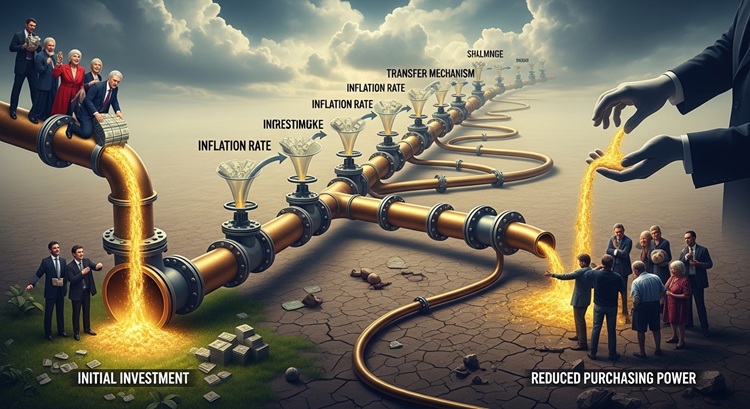
Most people think of inflation as rising prices. You go to the supermarket, things cost more, and that’s about it. But that’s only the surface.
Underneath, something else is happening. Money is quietly shifting from one group to another. Not in a visible way, not like a payment or a transaction, but slowly, over time.
That is what makes inflation interesting. It is not just about things getting expensive. It is about who ends up better off and who does not.
When inflation shows up, it does not hit everyone at once. That is where things start to get uneven.
Some people see their income rise fairly quickly. Others wait months, sometimes years. Some hold assets that move with inflation. Others just sit on cash.
So even though inflation is happening across the whole economy, the impact is very different depending on where you stand. This difference in timing is where the wealth transfer begins.
Table of Contents
The Problem with Fixed Income
If your income does not move, inflation becomes a problem almost immediately.
Think about retirees or people living on fixed salaries. Their income stays the same, but everything around them gets more expensive. Rent, food, energy, all of it.
There is no adjustment on their side, at least not right away.
Now compare that to someone who runs a business or works in a field where pay can change more easily. They might be able to raise prices, negotiate higher wages, or shift their income in some way.
The gap between these two situations grows slowly, but it does grow.
Debt Starts to Feel Lighter
This part can be overlooked, but it matters a lot. Inflation reduces the real value of debt.
If you borrowed money in the past and inflation rises, you are paying it back with money that is worth less than before. The number stays the same, but the value behind it changes.
It does not feel obvious when you make the payment, but over time, the burden becomes easier.
For someone with a fixed-rate loan, especially over many years, this can make a real difference.
On the other side, if you saved money instead of borrowing, inflation works against you. The value of those savings slowly fades unless it is placed somewhere that keeps up.
So, without doing anything, just by existing in that environment, value is being shifted.
The Quiet Advantage of Owning Assets
There is also a clear difference between holding assets and holding cash.
Cash is simple; it stays the same. But its purchasing power does not.
Assets behave differently. Real estate, stocks, sometimes even commodities, they tend to move with inflation, at least over time. Not perfectly, not always in a straight line, but they adjust.
So if someone owns assets, they have a kind of protection. Not full protection, but enough to keep up in many cases.
If someone holds mostly cash, they do not have that.
This is one of the reasons why inflation tends to widen the gap between people. It rewards ownership more than saving.
Wages Don’t Catch Up Right Away
A common assumption is that wages rise with inflation. Sometimes they do, but rarely at the same speed. Usually, prices move first. Wages follow later. That delay creates pressure. People feel it in their daily lives. Expenses go up, but income stays where it is for a while.
Some workers eventually catch up. Others do not. And even when wages rise, they just restore what was already lost. They do not necessarily improve the situation.
Central Banks and the Bigger Picture
At some point, central banks enter the picture.
They lower rates, increase liquidity, and try to support the economy. In the short term, it can work. Markets move, activity picks up.
But there is another side to it. When money becomes easier to access, asset prices rise. Stocks, property, things like that. People who already own these assets benefit first.
Those who do not are still dealing with rising costs. So even policies that are meant to support the economy can end up shifting wealth in a certain direction. Not intentionally, but that is the outcome.
Governments and Inflation
Governments also play a role, whether directly or indirectly.
If a country has a lot of debt, inflation can actually help. It reduces the real value of what they owe over time. At the same time, tax revenues increase as prices and incomes rise in nominal terms.
From a fiscal point of view, this can ease pressure. But again, nothing disappears. The cost is simply passed on. Households deal with higher prices. Purchasing power declines. It is not always obvious, but the shift is there.
Inflation as a Hidden Tax
This is why inflation is called a hidden tax.
There is no line on a statement that says you paid it. No official rate that is applied directly to your income. But it still takes something from you.
You notice it when your money does not go as far. When things that used to feel affordable no longer do. And the difficult part is that it does not affect everyone equally.
So Who Actually Benefits?
It is not all negative. Some groups do benefit from inflation.
Usually, it is people who:
- Borrowed money at fixed rates
- Own assets that rise in value
- Can adjust their income relatively quickly
- Have pricing power in their business
They are not immune to inflation, but they are better positioned to deal with it.
And Who Struggles More?
On the other side, some people are more exposed.
- Those relying on fixed income
- People holding large amounts of cash
- Workers in sectors with slow wage growth
- Anyone without access to assets
For them, inflation tends to feel heavier, and the options to adjust are limited.
Why It Builds Over Time
The effects of inflation are not always dramatic at first. It is not like a sudden shock. It is more like a slow shift.
A bit of purchasing power lost here, a small adjustment there. Over time, these changes add up.
One cycle might not seem like much. But over several years, or across multiple cycles, the difference becomes clear. This is where inequality starts to widen.
What Can Be Done About It
There is no perfect way to avoid inflation. It is part of the system. But there are ways to reduce how much it affects you.
People usually move in a few directions:
- Trying to hold assets instead of only cash
- Looking for income that can adjust over time
- Being careful with long-term cash savings
- Using debt in a controlled way when it makes sense
None of these are perfect solutions. They all carry risk in different ways.
But doing nothing is also a choice, and not the best one.
In a Nutshell
Inflation is easy to misunderstand.
On the surface, it looks like prices are going up. But underneath, it is changing how wealth is distributed.
Some people move forward. Others fall behind. And most of the time, it happens quietly.
Not in one big moment, but in small shifts that build over time.
Once you start looking at inflation this way, it feels different. It is no longer just a number in a report. It becomes something that shapes outcomes, sometimes without people even realizing it.